Redmi vs Realme: Which Budget Phone Brand Wins in India?
- Electronics Gadgets
Aayushi
- 0
- 25 minutes read
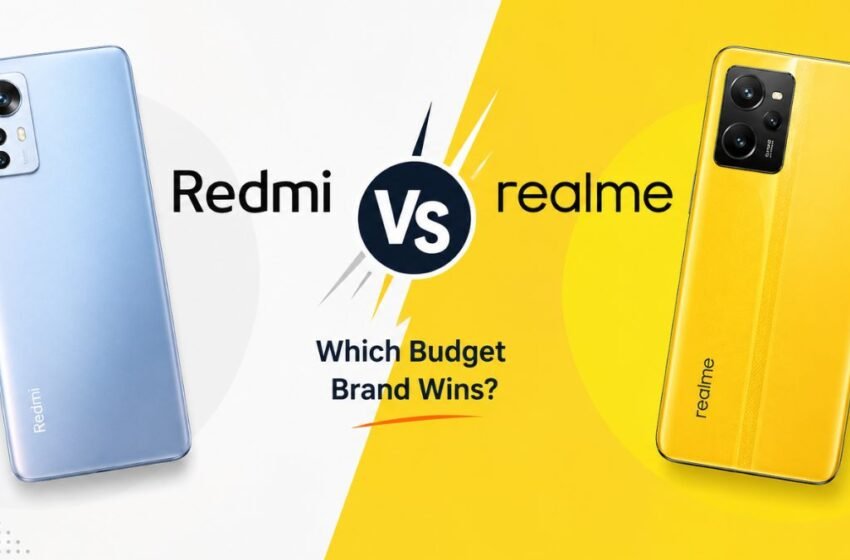
Redmi vs Realme: Which Budget Phone Brand Wins in India?
An honest, side-by-side breakdown of cameras, battery life, processors, gaming, and value — so you can stop second-guessing and start buying.
- Why Is This Comparison So Popular Among Indian Buyers?
- Understanding Redmi’s Position in the Budget Market
- How Realme Became a Strong Competitor to Redmi
- Which Is Better for Everyday Performance?
- Camera, Battery, and Gaming Compared
- Are Realme and Redmi the Same?
- Which Offers Better Value for Money in 2026?
- Final Verdict
- Quick Comparison Table
- Frequently Asked Questions
Choosing between Redmi vs Realme solely depends on you: whether it’s in terms of good quality, rich-featured hardware that balances all of its components, or if it is in terms of some innovation such as high charging capability and design. The competition in the budget smartphones India segment, dominated by Redmi vs Realme, guarantees a phenomenal price-to-value.
Buying a new smartphone can be very confusing, especially when you’ve got the two big names in town coming out with options at almost the same price. So don’t stress about your next big smartphone purchase — let’s resolve the Redmi vs Realme dispute head-on and compare these two phones to find the perfect one for you considering cameras, battery life, processor, and more.
Redmi vs Realme – Why Is This Comparison So Popular Among Indian Buyers?
Walk into any mobile shop across a Tier-2 or Tier-3 Indian city, and odds are that for the entire day you won’t hear a different question from customers: Redmi or Realme? The Redmi vs Realme comparison has easily evolved into one of the most-searched queries under the “budget smartphones India” bucket for the obvious reason that you’re looking for a device with a premium feel, assured performance, and one that doesn’t dent your pocket at month-end.
This isn’t about a good phone and a bad one. This is a fight between two companies that’ve spent years understanding just what an Indian buyer wants — and that’s precisely why this choice is a tougher nut to crack.
Understanding Redmi’s Position in the Budget Smartphone Market
Redmi launched in India as Xiaomi’s budget-conscious sub-brand, and its growth has been fueled by a single pledge: bringing flagship features to an unthinkable cost. This is evident in just how most Redmi phones are specced out — massive batteries, hearty processors, and screens that far outperform their respective price points.
If you’ve owned a Redmi phone before, you already know what to expect from the next one. That consistency is deliberate. Redmi rarely surprises you, and for a buyer who wants predictable, dependable performance without research fatigue, that’s a genuine advantage.
Redmi’s core strengths: Strong battery capacity for all-day usage, Snapdragon and MediaTek chipsets tuned for stable everyday performance, MIUI/HyperOS with deep customisation options, and a wide offline retail presence across smaller Indian cities.
This groundwork is exactly why Redmi still commands a loyal buyer base, even when newer competitors try to out-spec it on paper.
How Realme Became a Strong Competitor to Redmi
Realme chose a different path, forgoing the common recipe in favour of a style-focused buyer who spends just as much time playing games on their smartphone as scrolling through their feed. Their design ethos conveys this clearly: slender designs, bolder colour options, and software that looks that much fresher out of the box.
While Realme’s software is not always great, their charging efforts have consistently been stronger than Redmi’s, often pushing out faster wattages in the same price range. This is a key differentiator for many buyers, especially in a world where you rush to leave the house only for your phone to die just a minute before.
Which Is Better: Realme vs Redmi for Everyday Performance?
When you ask which is better, Realme or Redmi for daily use, the honest answer depends on how you actually use your phone. If your day involves calls, browsing, social media, and the occasional video, both brands will serve you well. Push into gaming or multitasking, and the differences start to show.
Processor and Speed Comparison
In terms of Redmi vs Realme performance, Redmi tends to favour thermal stability. Its chipsets, particularly in the Note series, are tuned to maintain consistent speeds over long sessions rather than chase peak benchmark numbers. You’ll feel this during longer calls or extended navigation use — the phone stays cooler, and app switching remains smooth.
Realme, on the other hand, frequently pairs its phones with chipsets built for raw throughput, especially in its Narzo and GT-adjacent lines. If you care about frame rates in games or quick app launches, Realme often edges ahead in short bursts, even if it runs slightly warmer under sustained load.
Software Experience and User Interface
Both companies ship an Android-based custom skin on practically every device in the Android smartphone under ₹20,000 series. However, in day-to-day usage, Redmi’s HyperOS aims at hyper-personalisation and greater synergy within the entire Xiaomi ecosystem of products. Realme UI offers an experience closer to stock Android, and therefore relatively intuitive for new smartphone buyers.
Your existing smart home or wearable tech ecosystem may alone be enough to sway the final purchase before specifications are even considered.
Realme or Redmi: Which Is Best for Camera, Battery, and Gaming?
This is where most buyers actually make their final call. Realme or Redmi which is best usually comes down to three things you use every single day: your camera, your battery, and how your phone handles the games you already play.
- Natural, true-to-life camera colours
- Larger battery capacity (2-day moderate use)
- Better thermal management for longer gaming sessions
- Consistent app-switching performance
- Punchy, social-media-ready photo output
- Significantly faster charging speeds
- Higher refresh rates for gaming
- Better frame-rate stability in BGMI, Free Fire
Camera Quality Comparison
Xiaomi’s cameras tend to produce daylight colours that look more natural and true to life — photography enthusiasts may find these ideal for editing afterward. Realme aims at richer, saturated photos straight from the camera app; images that look awesome posted directly on social media without any post-processing.
Photography in very poor light is something both brands are still working to overcome at lower price tiers, with upper models progressively addressing these limitations.
Battery Backup and Charging Speed
When comparing Redmi and Realme battery life, Redmi often takes the title of higher battery capacity, usually packing bigger cells that can last over two days with moderate usage. However, Realme competes in battery longevity by offering significantly speedier charging — even if a Realme battery size is slightly smaller than a Redmi’s, it takes up considerably less time at the plug. This feature becomes paramount if your schedule doesn’t leave much room to keep your phone hooked up throughout the day.
Which Phone Is Better for Gaming: Redmi or Realme?
When comparing which smartphone is the best for gaming, Realme comes out on top in the sub-₹20,000 segment. Most gaming-focused Narzo series phones get high refresh rates and chipsets tweaked for frame-rate stability to run games like BGMI and Free Fire more seamlessly.
Redmi isn’t far behind though — their much better thermal management often enables longer gaming sessions that stay consistently smooth, even if the peak frame rate trails the top Realme device at the same budget.
Are Realme and Redmi the Same? Here’s What Makes Them Different
You might assume Realme and Redmi are basically the same phone with a different logo, since both came out of similar corporate roots. That assumption isn’t accurate, and understanding why matters before you spend your money.
Brand Ownership and Ecosystem
Redmi is effectively a subsidiary in Xiaomi’s massive range of smart electronics — spanning smart TVs, wearables, and home security hardware. Realme detached itself from its BBK Electronics relatives (including Oppo) and established itself as a separate company with its own manufacturing lines, distribution chains, and product philosophies. Its independence results in more enthusiastic exploration of new tech ideas compared to the typically cautious, Xiaomi ecosystem-compliant Redmi.
Design Philosophy and Software Differences
Redmi designs for longevity and familiarity — you’ll notice its flagship-adjacent design language barely changes year over year. Realme takes more design risks, refreshing its look and colourways more aggressively to stay relevant with younger buyers who upgrade phones more frequently.
Redmi vs Realme – Which Offers Better Value for Money in 2026?
Value isn’t just about the lowest price tag. When you weigh Redmi vs Realme for value for money, you need to factor in what you get for what you spend, not just the sticker price itself.
Best Options Under Different Price Segments
| Price Segment | Redmi | Realme |
|---|---|---|
| Under ₹15,000 | Wins on battery & expandable storage | Competitive but trails slightly |
| ₹15,000 – ₹20,000 | Note series catching up | Leads with AMOLED & 45W+ charging |
| ₹20,000 – ₹25,000 | Balanced specs across the board | Strong but less consistent |
| 5G Budget Phones | 5G standard near ₹12K–₹15K | 5G standard near ₹12K–₹15K |
Long-Term Software Updates and Reliability
This is where your buying decision should really slow down. Redmi has generally offered more consistent long-term software support across its Note series, which matters if you plan to keep your phone for three years or longer. Realme has improved significantly here too, though its update rollout across older models has historically been less predictable.
Should I Buy Redmi or Realme in India?
If you prioritise battery life, thermal stability, and long-term software support, Redmi is the safer, more dependable choice. If you value fast charging, a sleeker design, and slightly stronger gaming performance at the same price point, Realme is likely to serve you better.
Neither brand is objectively superior in every category. Your final answer should come from how you actually use your phone every day, not from spec sheets alone.
Redmi vs Realme: Quick Comparison Table
| Parameter | Redmi | Realme |
|---|---|---|
| Battery Life | Larger capacity, longer runtime | Smaller capacity, much faster charging |
| Performance | Stable, thermally consistent | Faster peak speeds, warmer under load |
| Camera Output | Natural, true-to-life colours | Punchy, social-media-ready shots |
| Gaming | Consistent over long sessions | Higher refresh rates, better frame stability |
| Design | Simple, familiar year-on-year | Sleeker, more frequent style refreshes |
| Software Updates | More consistent long-term support | Improving, historically less predictable |
| Best For | Dependability, battery-first users | Style-conscious buyers, casual gamers |
Frequently Asked Questions
Redmi vs Realme: What Is the Best Budget Smartphone Brand in India?
Redmi vs Realme is less about a universally perfect smartphone brand in the budget segment and more about finding what suits your usage best. The benefit you gain with Redmi is battery life, thermal performance, and long-term software support. With Realme, you get superior charging speeds, design, and slightly better gaming performance for similar price points.
For those still evaluating the best budget smartphone brand in India, think about how you use your smartphone day-to-day: gaming, photos, charging patterns, and how long you plan to keep the device. This single reflection alone should answer your question more than any spec sheet could.
Once you find what works better for you between Redmi vs Realme in terms of value for money with respect to your daily routine, you’re guaranteed to make the right decision. Before checking out your chosen device, ensure you check out all the different listings and offers on the model you’ve selected — you might find some exciting deals.
Disclaimer: This article is intended for general informational purposes only. Prices, specifications, and software update timelines mentioned here may vary by model, region, and time of purchase. Readers are advised to verify current details on official brand websites or authorised retailers before making a buying decision.
Last Updated on: August 18, 2026